In this article
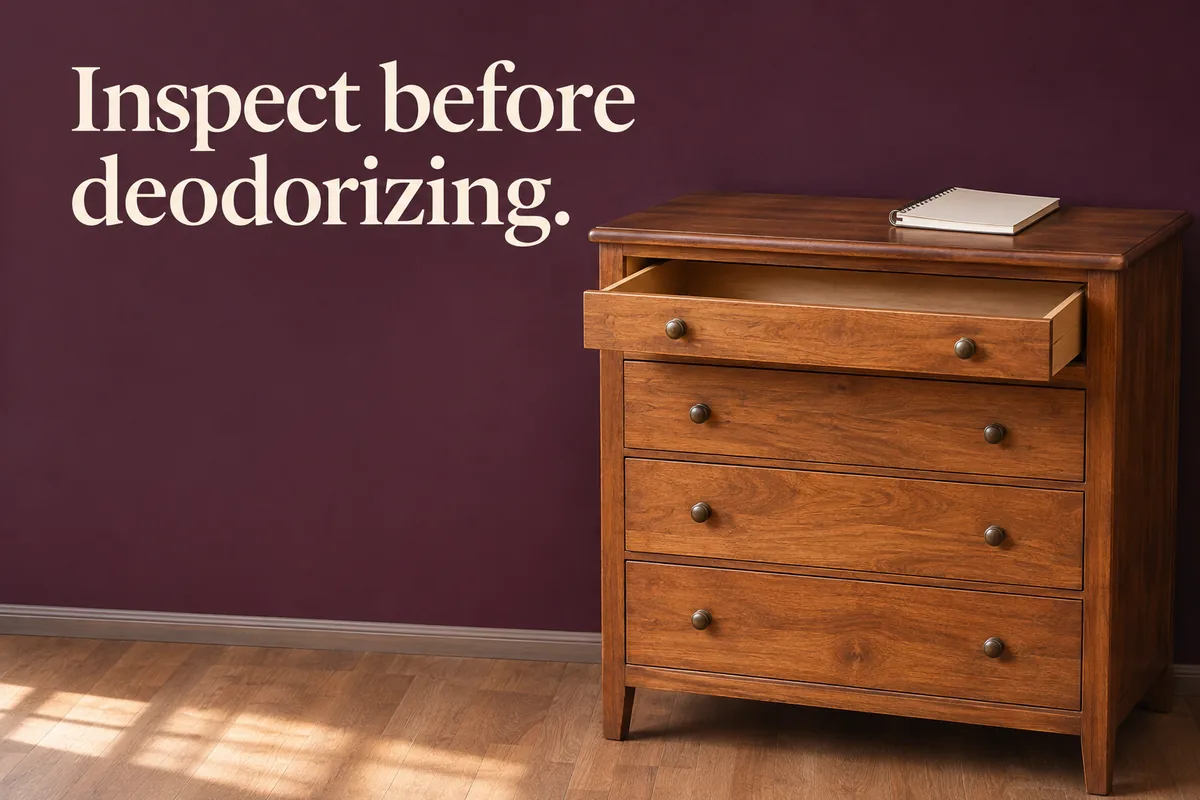
Empty the dresser, pull the drawers and find which part smells: often a paper liner, an unfinished drawer bottom or the back panel. Look for stains, swelling or growth before you deodorize. If it's just stale storage odor, cleaning what the finish allows, airing it out in a dry room and an unscented absorber usually help. A musty smell can signal mold; EPA says it's worth investigating, and a piece with water damage may need a specialist or a return.
Keep the dresser empty while you establish the problem
Save the seller's description, photos and purchase record before altering anything. Note when you first noticed the smell: at pickup, after transport, when a drawer opened or after the dresser spent time in your room. If you can still ask the seller about storage, leaks, cleaning or refinishing, those details are more useful than an unexplained promise that an old-wood smell is harmless.
Don't put clean clothes in to test it. Keep the dresser in one place for inspection instead of moving it through bedrooms.
Describe the odor in ordinary terms and record where it seems strongest. You do not need to identify a compound or take repeated close sniffs. If the item causes symptoms or you have a health concern, stop the inspection and seek appropriate advice rather than using your reaction as a home diagnostic test.
Inspect the drawers, liners and cabinet separately
Look at one accessible part at a time under good light. Follow the hardware directions if a drawer can be removed, and keep track of its original position. A drawer front, unfinished interior, thin back panel and drawer bottom may be different materials. Do not assume the entire dresser is solid wood because the top has visible grain.
| Area | What to record |
|---|---|
| Drawer contents or removable liner | Whether the odor changes when that item is set aside appropriately |
| Drawer interior and bottom | Stains, swelling, lifted material, residue or finish changes |
| Cabinet back, underside and feet | Visible water history, surface condition and inaccessible areas |
| Surrounding room or storage location | Dampness or another odor source that could affect the furniture |
A liner that smells different from the drawer is a useful clue, but it doesn't tell you the wood is fine. A clean-looking front says nothing about the drawer bottom.
Investigate mustiness without diagnosing by smell
EPA's explanation of mold odors says a moldy odor suggests possible growth in a building and should be investigated. That supports taking a musty smell seriously. It does not identify a mold species, establish which dresser component is affected or certify an item as safe when the smell fades.
If you find suspected growth, ongoing dampness or a history of substantial water exposure, stop treating the job as ordinary deodorizing. EPA's home mold guidance emphasizes correcting moisture and notes that mold can be difficult to remove completely from porous materials. It recommends specialist help when the cleaning method is uncertain or the item is valuable. A bare drawer bottom should not automatically receive the same treatment as a washable hard surface.
Look beyond the dresser as well. If the room has a known leak or repeatedly damp conditions, moving a cleaned item back into the same situation does not resolve that source. Keep a short timeline of where the piece was stored and what water problems are known. If contamination or pest evidence is suspected, obtain appropriate assessment before choosing a cleaning method.
Choose cleaning for the actual material and finish
For an item suitable for routine cleaning, first obtain the maker's care information if it exists. Keep instructions for the finished exterior separate from those for unfinished interiors or engineered panels. A household cleaner labeled for one surface does not establish compatibility with every surface inside an old dresser.
The Canadian Conservation Institute's furniture-finish guidance explains that finishes vary and original coatings can have historical, aesthetic and financial value. Water and solvents may affect vulnerable surfaces. Use that preservation principle to avoid experimenting with an unidentified antique finish; its museum-care procedures are not a universal household deodorizing recipe.
If the care directions allow cleaning, test the method on a small hidden area first and look again once it's dry.
Do not confuse a changed smell with a corrected source
Start without fragrance so you can tell whether the smell is really fading. An open container of an unscented absorber, such as baking soda or activated charcoal, kept inside a closed drawer can help with stale storage odors; it won't fix moisture or mold.
Do not default to an ozone generator for a dresser or the room containing it. EPA's review of ozone air cleaners explains that ozone can harm the lungs and has limited potential to remove indoor contaminants at concentrations within public-health standards. That is not a household shortcut for making unknown furniture conditions acceptable.
Sealing an interior is also a finishing decision, not an inspection. Before adding a coating to drawer bottoms or hidden wood, establish the source, substrate preparation, compatibility, cure and intended storage use. A dry-looking coat on one face does not demonstrate that the rest of the assembly is dry, sound or suitable for storing clothing.
Decide whether the piece is worth treating
Bring the observations to the seller, maker or an experienced furniture restorer. Provide the construction information, photos, odor locations and known moisture history. Ask which part needs treatment, how inaccessible areas would be handled and what outcome can reasonably be assessed. A promise to make every old dresser odor-free is less useful than a method tied to the actual condition.
- Return or decline the piece when the uncertain condition and treatment cost do not fit your needs, while following the agreed purchase terms.
- Use an appropriate specialist when suspected growth, water damage, fragile finishes or inaccessible material makes the task unsuitable for routine cleaning.
- Proceed with ordinary care only when the condition and surface directions support it; keep the piece empty until the work and required drying are complete.
A low price doesn't justify overlooking a problem, but a musty smell doesn't automatically mean the whole piece is ruined either. It depends on what's affected and what treating it would involve.
Recheck before putting clothing inside
After the agreed work and drying, revisit the same drawer and cabinet locations under normal room conditions. Record any remaining odor or visible change before adding liners or clothing. If the smell returns after the drawers have been closed, report that recurrence instead of covering it with another fragrance.
For suspected mold work, the endpoint is more than a pleasant smell. EPA's guidance calls for the moisture problem to be corrected and the cleaned area to be revisited for signs of renewed damage or growth. If uncertainty remains, keep storage use on hold and obtain the next assessment. A dresser is useful when you can care for it confidently, not simply when it photographs well.
Before clothes go back in
- No visible growth, stains or swelling in drawers and back panel
- The smell is gone or much fainter with no fragrance added
- Everything cleaned is completely dry
- The room it lives in isn't damp; aim for under 60% humidity
- New liners are unscented, so you'll notice if the smell returns
Common questions
What absorbs musty smells in wood furniture?
Unscented absorbers such as baking soda or activated charcoal in an open container inside closed drawers can help with stale storage odors. They don't fix dampness or mold.
Does a musty smell mean mold?
Not always, but EPA says a moldy odor suggests possible growth and should be investigated. Look for stains, fuzz or water damage, and treat it as a mold cleanup if you find any.
Can I put a dresser in the sun to remove odor?
Brief airing in dry, mild conditions can help, but strong sun and heat can fade finishes and dry out wood. Shade and ventilation are safer.
Should I seal the inside of the drawers?
Only after the smell's source is fixed. Sealing over a musty or moldy surface traps the problem rather than solving it.