In this article
Protect a wood floor under a rolling chair with one of two setups: casters made for hard floors that fit your chair, or a smooth-backed chair mat (never a spiked carpet mat) sized to every spot the wheels reach. Either way, keep grit off the wheels and the floor, because trapped debris does the scratching.
Start with the floor, chair and mat records
Find the flooring care instructions and the chair's model or parts information. If you already have a mat, locate its model and intended floor type too. In a rental, ask the property manager for the floor information rather than guessing from the wood pattern or sheen.
| Identify this | What you need to establish |
|---|---|
| Floor and current finish | Permitted cleaning, mat materials and backing; any conditions after refinishing |
| Chair and casters | Approved wheel options, fitting instructions and intended floor surfaces |
| Mat, if used | Correct floor type, material and backing, support requirements, size and care |
Solid wood, engineered wood and wood-look floors each have their own care rules, and a refinished floor may have new ones. If the chair has started marking the floor, stop using it there until you know why.
Inspect every caster before changing the wheels
With the chair supported as its instructions require, look at every wheel and its fixing. Check for grit on the tread, trapped debris, a cracked wheel or one that no longer turns normally. Follow the chair maker's cleaning and service directions. Avoid dragging a jammed wheel or using a solvent on it simply because that cleaner is allowed somewhere else in the room.
If you need replacements, confirm compatibility with the exact chair. One chair maker's replacement-caster information lists the chair models its part fits and distinguishes it from a carpet option. That is an example of model-specific evidence, not a recommendation that the part fits all office chairs or every wood floor.
Ask about fit, wheel type and whether the chair's height will change. Don't pick wheels just because they look softer or bigger. Install the full set as directed and test sitting and standing before getting back to work.
Match the mat underside and material to the finish
A mat maker's floor-type and sizing guide separates gripper-backed mats for carpet from smooth-backed mats for hard floors. Its selection and care instructions explicitly keep spiked mats off wood floors. Turning a carpet mat over is not a substitute for selecting an approved hard-floor product.
Backing is only part of compatibility. The care document also distinguishes material choices for varnished or lacquered wood and notes that some polished surfaces may be unsuitable even for an anti-slip mat. Check the exact mat against the current floor finish; neither a clear appearance nor the word hardwood settles the question.
Check the mat's load and temperature limits, and mention radiant floor heating or a recently refinished floor when you ask the maker.
Measure the rolling area, not just the space under the desk
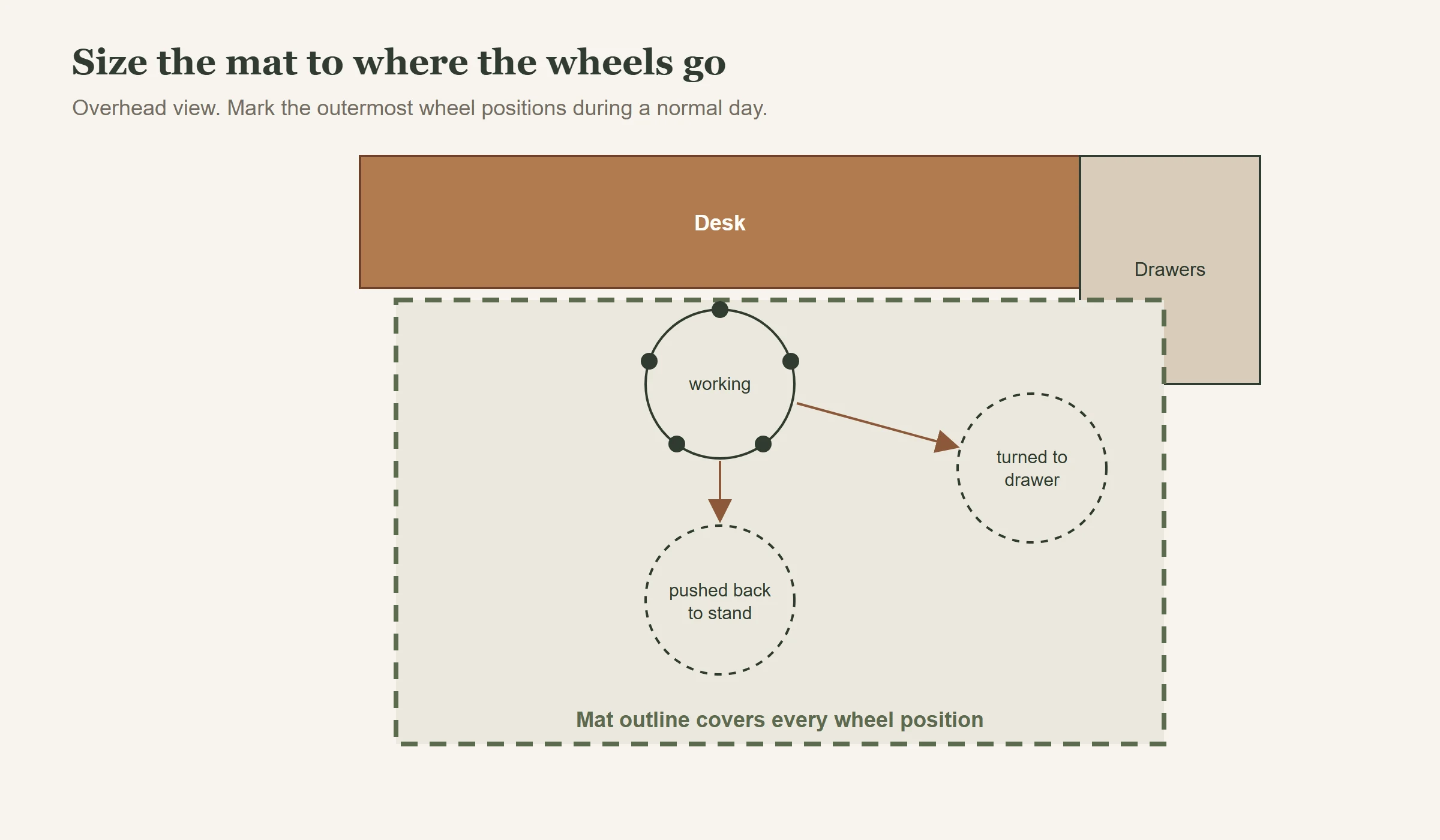
The sizing guide above recommends measuring the farthest points the chair rolls to during the working day. Include the wheels when you pull away from the desk, turn toward a drawer and move into position to stand. The seat's outline is not the wheel footprint.
- Sketch your desk, chair base, drawers and the route behind the chair. Note the usual working and getting-up positions.
- On an existing suitable protected setup, observe the outermost wheel positions during normal use. If the floor is being marked, stop and plan from stationary positions instead of rolling across it again.
- Record the needed coverage in inches, including the shape of any section that extends beneath the desk. Check usable coverage rather than assuming a narrow front lip protects the whole chair base.
- Compare a paper outline with the proposed mat shape while the chair is elsewhere. Keep the walking route and desk drawers usable, then remove the paper before using the chair.
Watch the route to a side cabinet as well as the movement directly behind the desk. If a wheel will repeatedly cross the mat edge, reconsider the mat size, shape or desk arrangement. A mat that sits neatly under the desktop may still miss much of the working area.
Set up a clean, dry and stable contact area
Move the chair aside without dragging it across the wood. Remove loose debris with the floor's approved method, and prepare the underside of the mat according to its instructions. The mat care document calls for a clean, dry floor, a fully flat mat and regular cleaning beneath it. Do not trap an existing spill under a new cover.
Let a rolled mat flatten as its directions say; don't force it flat with the chair or cut it without permission. Stop if it shifts, curls or rocks.
Clean the wheels, mat and floor as separate surfaces
The National Wood Flooring Association's maintenance guidance recommends removing dust and dirt with sweeping, dust mopping or a vacuum's bare-floor setting, and selecting a cleaner for the finish. Apply the floor's own directions beneath the workstation just as you would elsewhere in the room.
Keep a routine for inspecting the wheel treads and lifting the mat as its handling instructions allow. Clean the mat with its approved method, clean the floor separately and let both dry before replacing it. A cleaner suitable for the mat may not suit the floor, and a transparent mat can still hide debris until you move it.
Recheck after moving the desk, changing casters or changing how you use the chair. Deal with spills and new grit when you see them. No setup is maintenance-free.
Treat existing marks as a separate repair question
Photograph a new mark and note where it sits relative to the wheels and mat edges. After approved cleaning, describe what remains: a streak, change in sheen, scratch or indentation. That description is more useful to the flooring supplier than assuming every mark needs a polish, repair pen or sanding.
Correct the chair's contact problem while asking the floor maker, installer or refinisher about the affected finish. Protection prevents further wear only when the setup and care are appropriate; it does not erase an existing mark. For fixed dining-chair feet, use the separate chair-foot protection guide, since felt pads are not an instruction for treating a rolling caster.
Workstation floor check
- Mat backing suits hard floors and your finish
- Every wheel stays on the mat through your normal movements
- Mat lies flat with no curled edges
- Wheel treads free of grit and hair
- Floor under the mat cleaned and dry at the last check
Common questions
Do I need a chair mat on hardwood?
Not always. Hard-floor casters that fit your chair can protect the floor without a mat, provided you keep the wheels and floor clean. A mat adds protection where the chair moves a lot.
What size chair mat do I need?
Measure the farthest points your wheels reach during a normal day, including pushing back to stand and turning to a drawer. A mat that only covers the space under the desk leaves wheels rolling onto bare floor.
Can a chair mat damage a wood floor?
It can if grit is trapped underneath, if the backing is wrong (spikes are for carpet), or if the material doesn't suit your finish. Use a smooth-backed mat and clean under it regularly.
Are rubber or rollerblade-style wheels better for wood floors?
Choose by your chair maker's compatible parts and a hard-floor rating, not by appearance. The right fit and clean treads matter more than the wheel style.