In this article
A wooden board usually still smells because food is left in a groove or edge, the soap or oil left its own scent, or the smell is really coming from the sponge, towel or cabinet. Wash it again with hot water and unscented dish soap, dry it on edge, and for onion or garlic try a board maker's lemon-and-salt rub. A board that stays musty or has deep grooves should be replaced.
Trace the smell before choosing a treatment
Set the empty board apart from the sink, sponge, towel and stored produce. Check those items separately so you are not treating the board for a smell coming from something beside it. Include the drying rack or cabinet where it normally sits. Work in ordinary room air rather than holding an unknown-smelling surface against your face, and do not taste it to investigate.
Write down when the smell appeared: after chopping onions, after a different soap, after applying oil, or only after storage. Also note whether you notice it while the board is wet, when fully dry, or both. These observations help narrow the next step; none proves a chemical identity, microbial condition or particular defect.
A familiar onion smell after chopping onions is a different problem from a chemical or musty smell on a secondhand board. For a new board, keep the packaging and ask the maker before you treat it.
Check for residue before trying to deodorize
Look at the juice groove, edges and both usable faces in good light. Food caught in a corner or a patch that was only wiped deserves attention before another treatment. Review what 'washed' meant this time: a quick rinse, a wipe with the same cloth used elsewhere, or the full method specified for the board. Use a clean cleaning tool and follow the board's care directions.
USDA's cutting-board guidance recommends washing after each use with hot, soapy water, rinsing with clear water and drying. Keep the board's construction-specific restrictions in that process. For the full everyday routine, see the wooden cutting-board cleaning and care guide; this guide focuses on what to check when the smell remains.
The University of Maine Cooperative Extension's board-care guidance suggests unscented dish soap to avoid strong odors or residue on wood. If the fragrance began with a new detergent, check that change rather than covering it with another scent. Rinse as instructed, remove excess water and complete the specified drying before comparing the result. Do not compensate for incomplete rinsing with a longer soak.
Keep odor removal separate from food safety
The CDC distinguishes cleaning from disinfecting: soap, water and physical cleaning remove dirt and germs, while disinfecting chemicals act on remaining germs. A deodorizing step answers a different question: whether a smell is reduced. Do not use a citrus scent, a lighter-looking patch or the absence of an odor as permission to skip food-safety care.
If raw meat, poultry or seafood contacted the board, address that use through appropriate cleaning and food-contact sanitation instructions, even if there is no smell. USDA also recommends keeping a separate board for fresh produce and bread from the one used for raw animal foods. A lingering garlic smell on a produce board does not tell you whether another board used for raw chicken received the right care.
If you use a sanitizer, check that its label covers food-contact surfaces and that your board's maker allows it, then follow its dilution, contact time and rinse directions.
Use an odor treatment documented for the actual board
For ordinary onion or garlic smells on a sound board, one manufacturer's cutting-board FAQ recommends sprinkling the board with salt, rubbing it with a cut lemon or lime while squeezing out the juice, letting it sit 2–3 minutes, then wiping it clean with a damp cloth and drying it.
Stick to the short treatment; leaving lemon on overnight won't work better and adds moisture. If the smell is unfamiliar or keeps coming back, stop treating and look at the board's condition.
Do not automatically reach for cooking oil to hide the smell or make the board look renewed. The extension guidance above notes that cooking oils can become sticky or rancid. If you recently used one, report which oil and when it was applied; adding more of a different conditioner will not establish what is now on the surface. Resolve the residue and compatibility question first.
Set the board aside when condition or history is uncertain
Inspect for open joints, loose material and grooves that remain difficult to clean. USDA advises discarding excessively worn boards and those with hard-to-clean grooves. An odor that seems less noticeable does not repair those conditions. A split also needs a separate assessment; do not pour a deodorizer into it and assume the interior is now cleanable.
An unexplained musty smell does not identify mold by itself. Record the board's storage conditions and visible condition without diagnosing the cause from odor alone. If you cannot establish its food-use history or how to clean it appropriately, use another suitable cutting surface while seeking an answer. You can set a board aside without first proving exactly which substance is responsible.
| What you observe | Useful next step |
|---|---|
| A familiar food odor after an otherwise complete wash | Check for a food-specific method approved for this board |
| A new soap or care-product smell | Identify the product and review residue-removal instructions |
| Smell returns after cabinet storage | Check the cabinet, supports and drying process separately |
| Hard-to-clean wear or an unexplained condition | Keep it out of food preparation while deciding on replacement or assessment |
Avoid stacking treatments or using heat to force a result
Do not turn several online tips into one procedure. The CDC specifically warns against mixing household bleach or other disinfectants with additional cleaners or disinfectants because dangerous vapors can result. Keep a citrus or vinegar tip separate from any chemical sanitation instructions; do not improvise a sequence to make a treatment stronger.
Don't soak the board, bake it or run it through the dishwasher to drive out a smell; board makers warn that soaking can split the wood. Don't sand just to chase an odor either.
Recheck the dry board without adding another scent
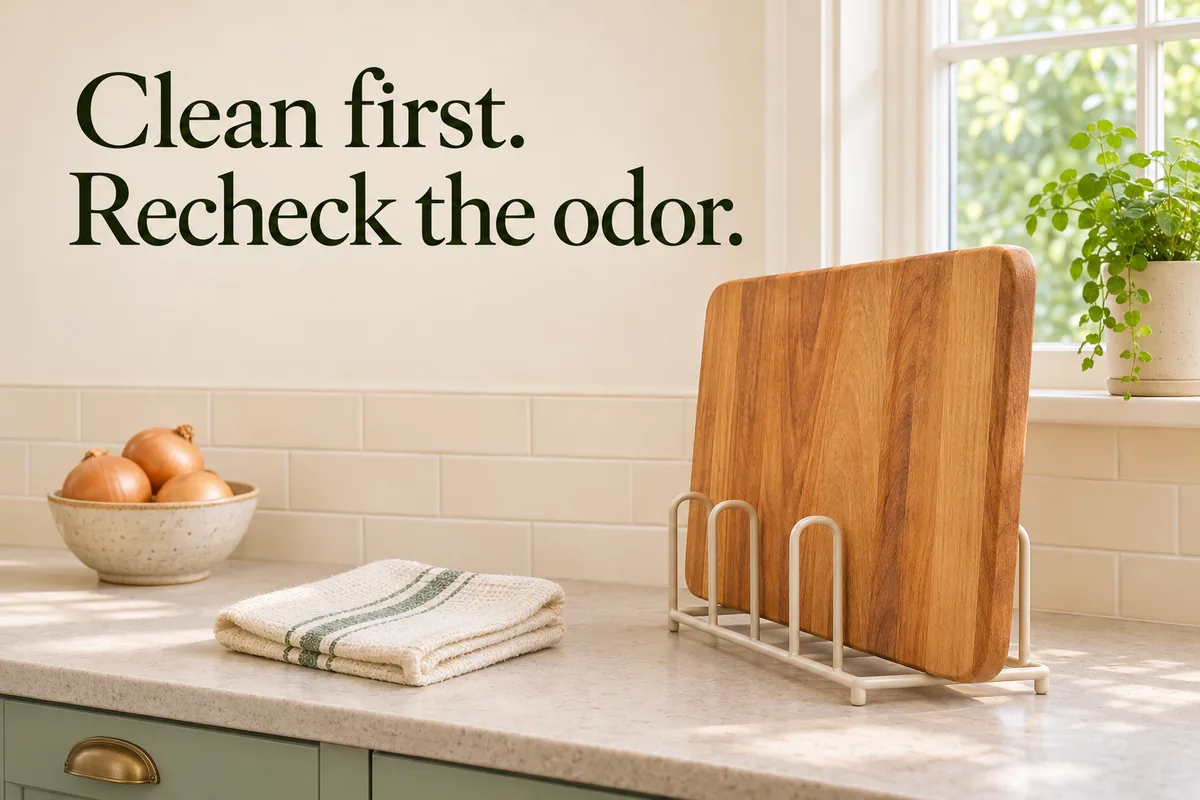
Use the board again only once it's clean, dry and sound. If it's too worn to clean properly, replace it. If an intact board still carries a food smell after good care, keep it for that food, such as onions and garlic.
Common questions
How do I get onion smell out of a wooden cutting board?
Sprinkle salt over the board, rub it in with a cut lemon or lime while squeezing the juice, wait 2–3 minutes, then wipe with a damp cloth, rinse and dry on edge.
Why does my cutting board smell sour or musty?
Often it's drying too slowly: stored damp, stacked, or kept near the sink. A musty smell alone doesn't prove mold. Dry it on edge with air on both faces, and replace it if the smell persists or the wood looks damaged.
Can I use baking soda or vinegar?
Only if your board's maker allows it, and never mixed with bleach or other cleaners. Rinse and dry thoroughly afterward.
Should I oil a smelly cutting board?
Not to hide a smell. Oil a clean, dry, odor-free board with food-grade mineral oil or board oil. Cooking oils can turn rancid and cause odors of their own.