In this article
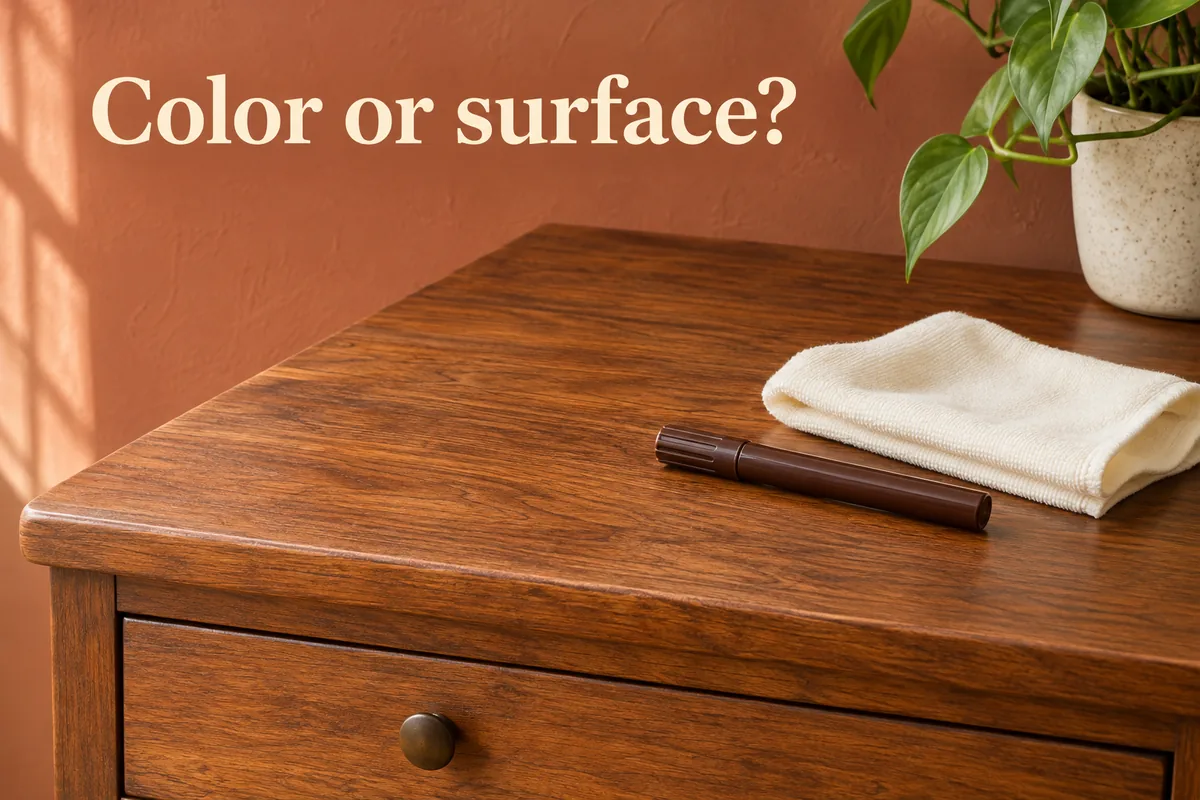
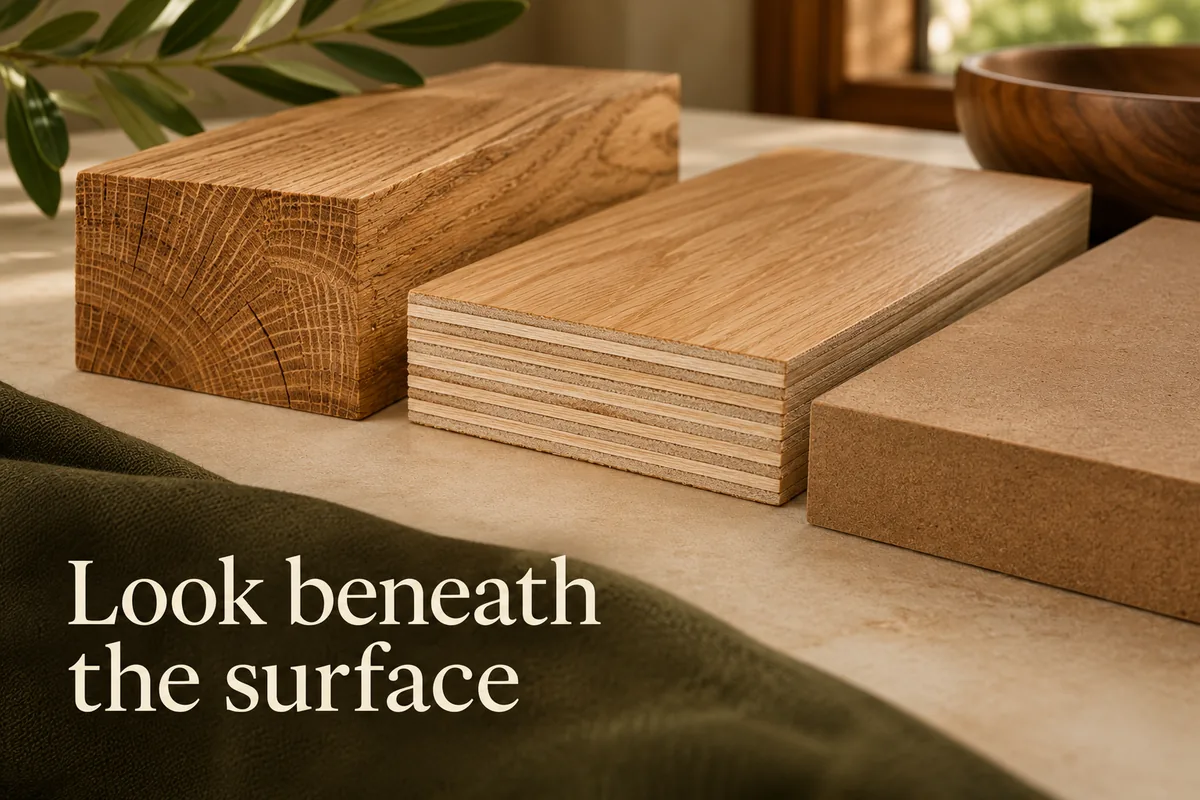
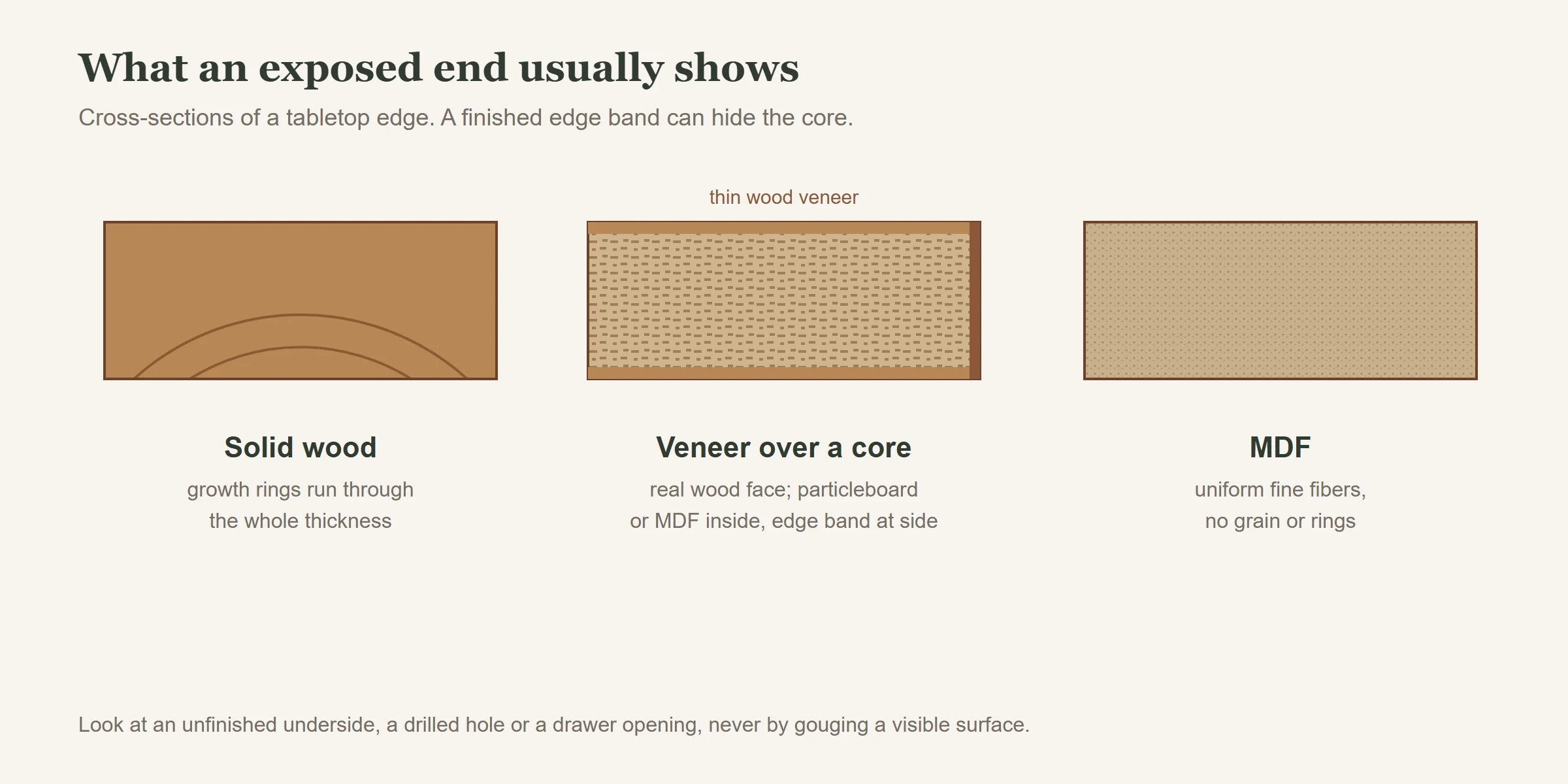
Check the material description part by part. The top, legs, drawer fronts and back are often made of different things, and "oak finish" names a color, not a wood. Then look where it won't cause damage: end grain at an unfinished edge or underside shows growth rings on solid wood and fibers or particles on MDF and particleboard. Veneer is real wood, but a thin layer over a core.
What do the material terms actually tell you?
A useful description separates the visible surface from the supporting material. A tabletop can have a wood veneer over an engineered core, while its legs are solid timber. Drawer fronts, drawer boxes, backs, and shelves may each use something different.
| Term in a description | What to establish next |
|---|---|
| Solid wood | Which component is solid, and what species is specified? |
| Wood veneer | What is the supporting core, and what is the edge treatment? |
| MDF or particleboard | What is the surface finish and how are exposed edges protected? |
| Plywood | What is the face material and what is the panel used for? |
| Oak or walnut finish | Is that a color description, a surface species, or the construction? |
For U.S. terminology, the EPA describes composite wood products as wood elements bonded with adhesives and identifies hardwood plywood, MDF, and particleboard as categories covered by its formaldehyde rule. A veneer is a surface layer; it does not, on its own, identify the material beneath. See the EPA consumer explanation of composite wood.
Where should you look without damaging anything?
Use good light and take photographs of accessible areas. Look under the top, at an existing unfinished edge, inside a drawer opening, or at a manufacturer-provided construction image. Do not gouge the back with a knife or drill a test hole in someone else's furniture.
End grain can be a useful clue. The wood-identification guide linked below shows how genuine end grain differs from the particles or fibers visible in manufactured boards. It also explains why repeating grain may suggest veneer. These clues need interpretation; an edge strip can conceal a core, and a photo may not show enough detail. See the wood identification guide.
Check more than one component. A solid-looking leg does not establish that the large top is solid. Likewise, a plywood drawer bottom does not prove that the entire dresser is MDF. Record the answer at the component level instead of forcing the whole item into one label.
Why can the edge be misleading?
A finished edge may be covered or constructed differently from the center. If a tabletop's face and edge seem unrelated, investigate rather than jumping to a conclusion. Ask for a cross-section description or a written materials specification when the construction matters to your purchase.
A dining-table specification on a U.S. retail site lists particleboard, oak veneer and solid oak all within the tabletop, with steel in the base. That's why the answer belongs to each part, not the whole piece.
Weight isn't a reliable test. Panel thickness, hardware and the mix of materials all change it.
Is veneer automatically a poor choice?
The label alone is not enough to decide whether furniture meets your needs. Ask what you want the piece to do, how it is assembled, whether replacement hardware is available, and how the maker expects you to care for it.
For a desk you will move between apartments, consider disassembly instructions, access through doorways, exposed edges, and how the fasteners are designed to be reused. For a dining table, consider the surface finish, daily spills, and the kind of repair you would accept later. These questions are more useful than treating one construction word as a universal quality score.
If you specifically want a solid-wood top for a future refinishing project, make that requirement explicit. A veneered top may still suit ordinary daily use, but it is not a substitute for a requirement you have clearly stated.
What should you ask an online seller?
Send a short, answerable request:
- What are the tabletop surface and core materials?
- Are the legs, apron, shelves, and drawer fronts made from the same material?
- Does the named wood refer to species, veneer, or finish color?
- What finish is applied, and where are its care instructions?
- Are there photos of the underside and edge construction?
- What assembly, repair, and return information applies to this version?
Save the reply with the listing and model number. If the answer is just "premium wood," you still don't know the construction.
What does a U.S. compliance label establish?
For covered composite products and finished goods, ask about the applicable TSCA Title VI compliance label. EPA explains what those labels must contain and the products to which the requirements apply. The label addresses the regulated emissions requirements; it is not a certificate that every component is solid wood, waterproof, or suitable for a particular load. See the EPA labeling questions.
Keep compliance, construction, and intended use separate in your notes. A seller should not have to guess whether you are asking about emissions documentation or about sanding a tabletop. Neither answer settles the other question.
What if you already own it and want to refinish it?
Document what you can identify and what remains unknown. If a thin surface layer is damaged, do not assume there is enough material to sand until the defect disappears. Previous repairs may also change what is possible.
For a used dresser, you might know that the drawer fronts have visible wood grain but still be unsure about the top. That uncertainty belongs in the repair plan. Ask a refinisher to assess the top before buying stripping products or beginning work. You can still clean or arrange the piece in the meantime using care guidance appropriate to its known finish and condition.
Questions to send the seller
- What are the top's surface and core materials?
- Are legs, apron, shelves and drawer fronts the same material?
- Does the named wood mean species, veneer or finish color?
- How thick is the veneer, and can the top be refinished?
- Does it carry a TSCA Title VI compliance label for composite wood?
Common questions
Is veneer furniture bad quality?
Not automatically. Veneer over a stable core can be durable and resists some seasonal movement. It matters if you plan to refinish deeply, because there's little wood to sand.
How can you tell if a table is solid wood?
Look at the end grain on an unfinished edge or underside: growth rings that continue onto the face suggest solid wood. Then confirm with the maker's material list, since edges can be banded.
Is MDF the same as particleboard?
No. Both are composite panels, but MDF is made from fine fibers and particleboard from larger chips. EPA groups both, with hardwood plywood, as composite wood products.
Can you sand veneer furniture?
Lightly, sometimes, if you know how thick the veneer is. Aggressive sanding can cut through to the core, so ask a refinisher first.