In this article
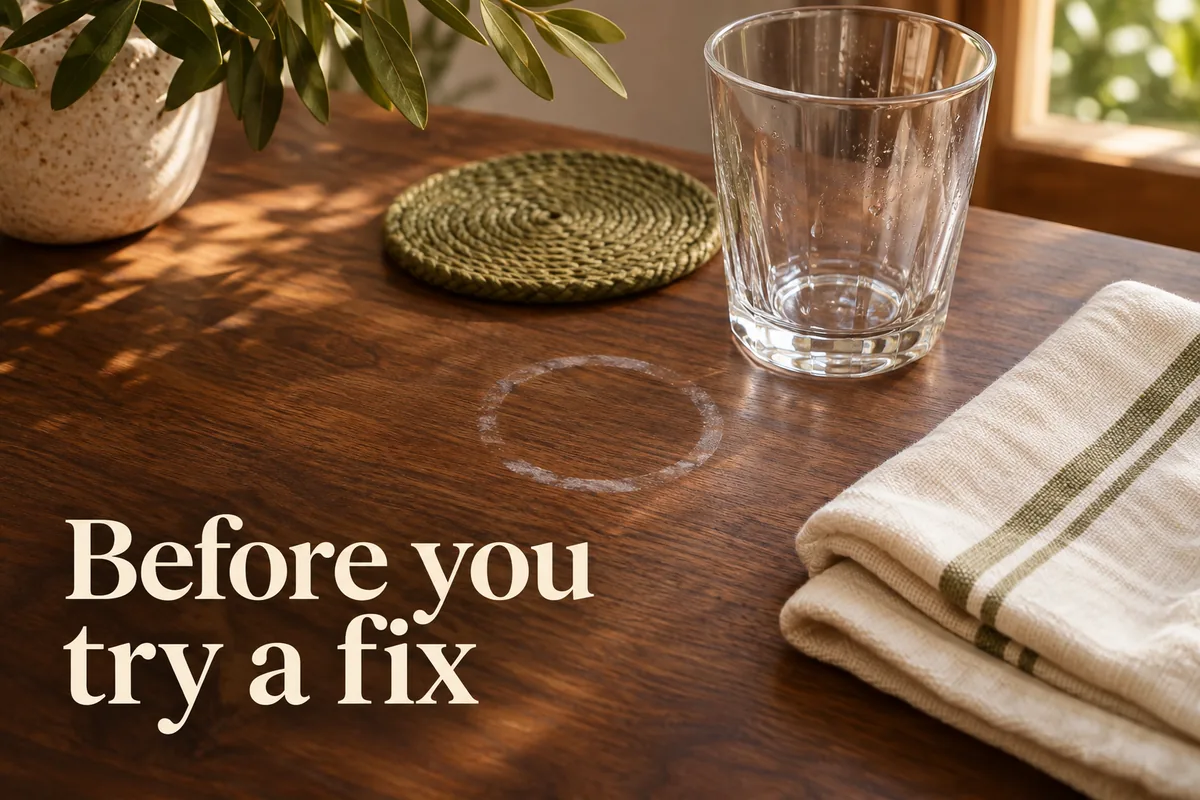
A white ring is usually moisture trapped in the finish, not damage to the wood itself. Blot the spot, let it dry in normal room conditions, and watch it: some rings fade as the moisture escapes. If it stays, identify the finish and try one method that suits it, testing somewhere hidden first. A dark stain, swelling or lifting veneer is a repair job, not a cleaning one.
Is it a white ring, a dark stain, or surface damage?
Look at the area in daylight and from a low angle. Is it a pale cloud beneath an otherwise smooth surface? Is it dark, rough, swollen, cracked, or lifting at an edge? Photograph both the close-up and the whole tabletop. Those details matter more than deciding immediately that the wood is ruined.
A finish maker describes white rings caused by moisture entering and damaging a coating. Its repair advice also warns that solvent or abrasive treatment can damage the finish or change the sheen. That supports a cautious diagnosis; it does not prove that your particular ring has the same cause or that its repair methods suit an unknown coating. See the guidance on white rings in finishes.
If the surface is raised or a thin top layer is lifting, do not press it flat with a hot iron or start sanding. A repair professional needs to distinguish a coating problem from damaged veneer, substrate, or adhesive. Dark marks also need their own assessment rather than the same recipe used for a pale cloud.
What should you do immediately after a spill?
Move the wet item and any damp coaster off the table. Blot remaining liquid without rubbing grit across the surface. Dry with a clean, soft cloth, then leave the area uncovered so you can observe it. Do not put a towel, tray, or placemat over a still-damp spot and forget it.
Let the table return to normal room conditions. Don't park it next to a heater or in strong sun to hurry it along. Note when the spill happened and whether the ring changes as it dries.
If the ring is fading, keep waiting. If it stays, identify the finish before trying anything else.
Why do heat, toothpaste, and alcohol give mixed results?
Different finishes tolerate different treatment. A method intended to release moisture or abrade a coating may also alter color, gloss, or the coating itself. Online before-and-after photos rarely tell you the full finish history, the amount of material removed, or what happened afterward.
For example, manufacturer advice for some modern coated furniture excludes alcohol, while the finish-maker page linked above discusses it in a repair context. These are not interchangeable instructions. The distinction between maintaining an identified finish and attempting a repair is essential. For general cleaning context, see care instructions organized by finish.
A hidden test can reveal an obvious problem, but it doesn't promise the ring will respond the same way. Don't try several methods on different parts of one ring; you can end up with a patchwork.
When can a ring-removal product be a reasonable option?
Consider one only after checking its permitted finish types and the furniture maker's guidance. Read exclusions as carefully as the headline. A product labeled for wood may have a narrower intended use than you expect.
- Confirm the tabletop construction and finish as far as possible.
- Save a clear before photo and a record of anything already applied.
- Read the furniture and treatment instructions together.
- Test where directed, allow the area to dry, and inspect the result.
- Treat only within the permitted directions; stop if color, feel, or sheen changes unexpectedly.
Do not interpret improvement while wet or oily as proof that the underlying damage is repaired. Inspect again after the product has reached the condition described in its directions. A shiny film can make a mark less obvious without resolving what caused it.
What if the table is veneer?
Find the original description or ask the maker. A veneered tabletop may have real wood on the surface and a different material beneath. Its appearance can be convincing, so grain alone is not permission to sand deeply.
If you do not know how much usable veneer remains or whether the piece has been refinished before, leave sanding out of the experiment. Ask a repairer whether the damage can be addressed within the existing finish, whether a larger area needs treatment, and what visual difference to expect afterward.
For an older or valuable piece, preserving the original finish may matter as much as removing the ring. The Canadian Conservation Institute furniture guidance recommends professional help for extensive cleaning or repair. Tell the professional about prior solvents, oils, heat, or abrasives; withholding that history makes assessment harder.
How do you decide whether to repair the spot or the whole top?
Imagine a pale ring on a frequently used dining table. A localized repair that looks acceptable under dinner lighting may be enough for you. The same patch on a highly polished, uninterrupted surface may remain noticeable from the side even when the white color improves.
Ask for an explanation of the proposed work, the area affected, and whether the color or sheen can change. If the table is new, contact the seller before altering it and keep the purchase record. Do not assume either that every ring is a warranty defect or that trying a repair cannot affect a claim.
Keep the next glass from becoming the next project
Choose a coaster suited to the furniture's finish and check underneath it when condensation is heavy. Put one within reach of the place people actually sit. A coaster stored in a drawer across the room is easy to ignore.
Keep working through your next question
Use a finish-aware cleaning routine. Check what the tabletop is made from.
Before any treatment
- The spot is fully dry and the ring hasn't faded on its own
- You know the construction (solid or veneer) and, ideally, the finish
- A before photo, plus a note of anything already used
- The treatment's label covers your finish type
- A hidden test spot checked after it dried
Common questions
Do white water rings go away on their own?
Sometimes. A ring caused by moisture in the finish can fade as the surface dries in normal room conditions. Give it time before reaching for a treatment.
Does a hair dryer or iron remove water rings?
It works on some finishes and damages others, especially veneer and older finishes. If you try heat, use the lowest setting, keep it moving, and stop at any change in sheen.
What's the difference between white and dark water rings?
White rings are usually in the finish. Dark rings mean moisture reached the wood beneath, which typically needs a refinishing repair rather than cleaning.
How do I prevent water rings?
Keep coasters within reach of where people actually sit, and lift plant saucers, damp cloths and serving dishes now and then to check underneath.