In this article
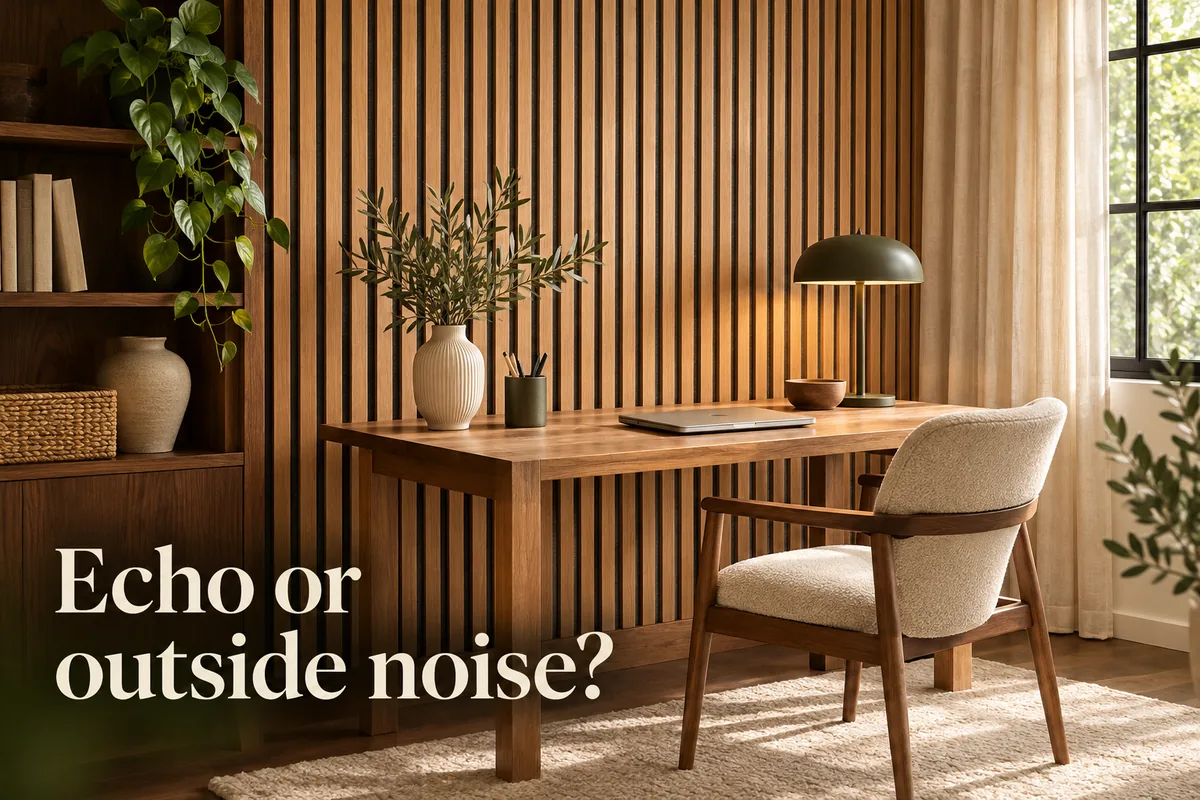
No. Acoustic wood slat panels can absorb sound and cut echo inside a room, but they don't soundproof it; stopping noise from a neighbor, the next room or the street depends on the whole wall, door and window. Slat panels are worth it when your problem is a hollow, echoey room. Check the absorption figure (NRC) and how the tested panels were mounted, because direct-to-wall, air-gap and insulated installations perform differently.
Is the sound echoing inside or arriving from outside?
Describe what bothers you in one sentence. Perhaps your voice sounds hollow on calls in an almost-empty office. Perhaps a television in the next room interrupts work. Or a truck outside is audible through a closed window. These are different starting points even if each is described as a noisy room.
Keep a short log of when the sound happens, where you hear it, and what is operating. Do you hear a long tail after speaking in the room, or a recognizable source elsewhere? This is a way to describe the complaint, not a measurement of the wall or a professional acoustic survey.
Before purchasing decorative panels, decide which outcome would count as improvement. A less echoing call and a private conversation in the next room require different evidence. Without that distinction, it is easy to buy a visually appealing treatment for the wrong problem.
What is the difference between absorption and isolation?
The NIH's explanation of sound design metrics separates NRC, which describes how much sound a surface absorbs and so how much a room echoes, from STC, which describes how much sound passes through a wall or floor. Slat panels are rated on the first, not the second.
Ask for evidence appropriate to your goal. If the problem is room echo, a tested absorption system may be relevant. If the problem is transmission between rooms, ask about the whole separating construction and the routes sound can take. A panel's wood finish or felt backing does not supply that information.
Avoid claims such as a 90 percent quieter room unless a source establishes exactly what was measured under relevant conditions. A laboratory absorption result cannot be translated directly into that promise for your office or bedroom.
Why does installation change the advertised result?
One panel maker publishes different absorption results for panels mounted directly on the wall, with an air gap, and with mineral wool behind. The mounting changes the result, so a headline number only applies if you install the panels the same way.
Read the actual report when available. Match the panel type, backing, mounting depth, and test arrangement to the system you intend to install. Check which acoustic measure is reported; do not treat different metrics or classification schemes as interchangeable.
If the seller shows a number but cannot explain the associated installation, pause the purchase. Ask for the report and the instructions that correspond to it. The correct question is not simply how high the number is, but whether the tested assembly resembles your proposed work.
What should you ask before ordering panels?
Gather answers before calculating how many boxes to buy:
- Is the product decorative only, or is acoustic performance documented?
- What exact panel and mounting method were tested?
- Does the result describe absorption or transmission through a separating assembly?
- What backing, air gap, or additional material is required?
- How much wall depth will the finished system occupy?
- What substrate, fixings, edge finishing, and cutting instructions apply?
- What room-use, moisture, fire-performance, and maintenance documentation is available?
You don't need to be an acoustician to ask these. They just stop a broad "soundproof" label from standing in for real information.
How much of the wall should you cover?
There is no universal number of decorative panels that guarantees a particular room result. Ask the supplier or an acoustic professional to consider the room dimensions, existing finishes, use, and intended treatment. A small sample can help with color and construction but cannot demonstrate the performance of a whole room installation.
For a visual planning exercise, measure the wall and sketch the panel layout at scale. Mark outlets, switches, baseboards, corners, and any access that must remain available. Count cuts and finishing pieces rather than dividing area alone and assuming every panel can be used without waste.
Example: a 96-by-96-inch wall is 64 square feet. That's useful for estimating how many panels to order, not for predicting how much quieter the room will sound.
What should renters and home-office users do first?
If the room is newly furnished, settle the basic layout before committing to a fixed feature wall. Record the position where you take calls or listen, the usual door position, and the existing rug, curtains, and furniture. Then explain the remaining problem to the supplier or professional so the treatment is designed around the room you will actually use.
Renters should confirm permitted fixings and changes. Do not assume removable adhesive will suit the panel weight, wall finish, or fire-performance requirements. Use the product's installation method and get help for wall construction or services you cannot identify.
If outside or neighbor noise is the main issue, discuss the source and building paths with the responsible owner or a qualified acoustic professional before spending the budget on an accent wall. A decorative treatment may still be desirable, but its appearance and its noise-control role should be decided separately.
Set an honest expectation for the finished wall
Keep the installation details and test documentation with your order. After the room is back in normal use, compare the problem you identified at the start under similar conditions. Avoid treating a phone recording or a single hand clap as a certified performance measurement.
Ask the seller
- Is acoustic performance tested, or is the panel decorative?
- Which panel and mounting method was tested?
- Does the figure describe absorption (NRC) or transmission (STC)?
- What backing material and mounting depth does the result need?
- Fixing method, panel weight and fire-performance information
Common questions
Do acoustic slat panels block noise from neighbors?
Not meaningfully. Blocking sound depends on the wall's mass, airtightness and construction. Panels mainly change how sound behaves inside your room.
What NRC is good for acoustic panels?
NRC runs from 0 (reflects everything) to about 1 (absorbs most sound). Compare products tested the same way, and match the mounting you'll actually use.
Do slat panels help on video calls?
They can, if echo is the problem. Soft furnishings, rugs and curtains also absorb sound, so try those too and compare.
Are slat panels real wood?
Often the slats are wood veneer over MDF, mounted on a felt backing. Check the material list for each layer.