In this article
A floating shelf sags for one of three reasons: the board itself bends over its span, the shelf is loose on its hidden bracket, or the bracket is pulling away from the wall. Unload it and look from the side: a dip in the middle means the board, a front edge tipping down along the whole length means the attachment. Load ratings only hold for the specified shelf size, wall type and fixings, and usually include the shelf's own weight.
Is the shelf bending or rotating off the wall?
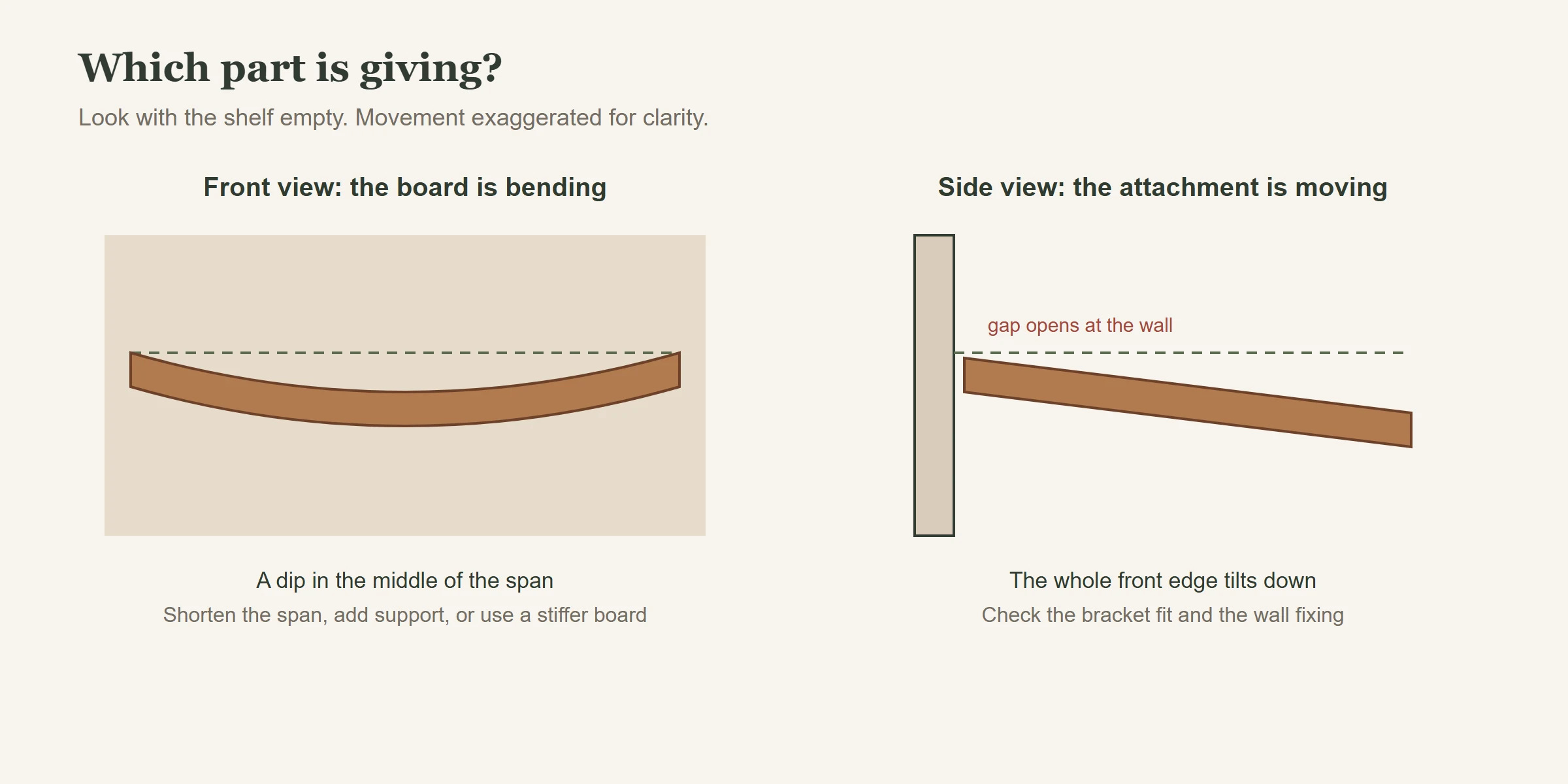
Look from the side and across the front without pushing down on the shelf. A dip in the middle of the span is different from a front edge that slopes downward along the whole length. A gap opening between a mounting plate and the wall is another issue again.
Take photos of the unloaded shelf, its bracket if visible, and the surrounding wall. Note when the change appeared and what had been stored there. If you see cracked wall material, loose fasteners, or new movement, keep the area beneath clear and have the installation assessed before reloading it.
Do not test it by leaning on the front edge or hanging from it. A shelf's everyday load is not the same as a person's weight applied to a small area. A failure can also damage the wall and the objects below, so a trial under body weight does not provide useful reassurance.
Why is the bracket's advertised capacity not the whole answer?
Start with the exact model's manual. Find the required shelf dimensions, bracket spacing, wall construction, fasteners, and definition of the load. Some ratings include the shelf itself; others describe the contents under specified conditions.
For example, one hardware maker describes a 125-pound combined shelf-and-contents capacity for a particular pair of supports, within stated shelf dimensions and with a system that engages wooden studs. That is an example of a conditional rating, not a capacity to apply to your shelf. See the hardware installation instructions.
Simple arithmetic: if a system allows 60 pounds total and the shelf weighs 18 pounds, about 42 pounds are left for contents, before any other limits in the manual.
What does evenly distributed load mean in practice?
A pile of plates at one end is not the same arrangement as smaller objects spread along a shelf. Likewise, moving a heavy item toward the front changes where its weight is applied. Use the arrangement permitted by the specific installation rather than treating the rated number as a shopping allowance for any placement.
A shelf assembly manual explicitly identifies its ratings as evenly distributed load and includes installation details intended to prevent sagging. Those conditions belong with the number whenever you interpret it. Read the shelf assembly and load instructions.
Before installation, group the items you expect the shelf to hold and measure their depth. Do not forget the filled weight of a planter or storage container. If you cannot establish the weight or the intended loading is outside the instructions, choose another storage location until the system has been specified appropriately.
Can you use the same anchors in every wall?
No. Identify whether the intended installation is into wood framing, metal framing, masonry, another substrate, or a wall system you have not yet identified. Then follow the shelf system's requirements for that construction. A box containing anchors does not establish suitability for every wall.
Check what the manual says about stud engagement, fastener size, spacing, and the shelf thickness needed to conceal the support. Do not mix a bracket, shelf, and fixing from unrelated systems without a supported design for the combination.
If you're unsure what's behind the wall, including wires and pipes, get installation help instead of drilling test holes.
What should you check before buying a deeper shelf?
Measure the objects you plan to store, then compare them with the permitted shelf dimensions for the support. A deeper shelf may be visually appealing, but the hardware may limit projection. The thickness and construction of the shelf can matter too.
For a kitchen shelf, lay out a few everyday dishes on a table first. Leave room to lift them without moving another stack. If the planned group needs a much deeper board than your support allows, do not make the shelf deeper and hope the advertised capacity still applies.
A decorative ledge holding a light frame and a kitchen shelf holding ceramics are different design tasks. Choose the system around the actual use. If you need enclosed storage, heavy appliances, or equipment that vibrates, a freestanding cabinet may be easier to specify and use.
Can you fix sagging by adding another bracket?
An additional compatible support may be part of a properly designed repair, but it is not a universal answer. The installer needs to know whether the shelf, support fit, fixing, or wall has failed. Adding hardware to damaged wall material does not itself establish a sound attachment.
Bring the photos, measurements, product manual, and intended contents to the person assessing the installation. Ask what needs to be replaced or repaired, and what load and arrangement the finished installation will allow. Keep that information available for future occupants or changes in use.
Make the shelf useful after it is secure
Put back only the items that belong to the agreed use. Keep daily objects within comfortable reach and do not turn a high shelf into storage that requires awkward lifting. Check the installation as its instructions recommend and pause if you notice a new gap, tilt, or movement.
Wall storage should clear a surface without creating a hazard above it. If a secure installation isn't possible in that spot, a different kind of storage is the better answer.
Before you load a floating shelf
- Shelf size within the bracket's stated limits
- Wall type identified and the specified fixings used
- Load rating read: does it include the shelf's weight?
- Heavy items spread out and kept toward the wall
- Filled weight counted for planters and containers
Common questions
How much weight can a floating shelf hold?
Only what its system is rated for, in the stated shelf size and wall type. One hardware maker rates a pair of supports at 125 pounds combined shelf and contents, under specific conditions; another system may be far lower.
Do floating shelves need studs?
Many hidden-bracket systems require fixing into studs or solid backing for their full rating. Follow the manual; drywall anchors alone often aren't enough for heavy loads.
Can I fix a sagging floating shelf?
Sometimes, by re-fixing a loose bracket, adding a compatible support, or replacing a board that bends. First work out whether the board, the fit or the wall fixing is the problem.
Are floating shelves good for dishes?
They can be, if the system is rated for the load and installed as specified. Measure your dishes' depth and weigh a typical stack before choosing.