In this article
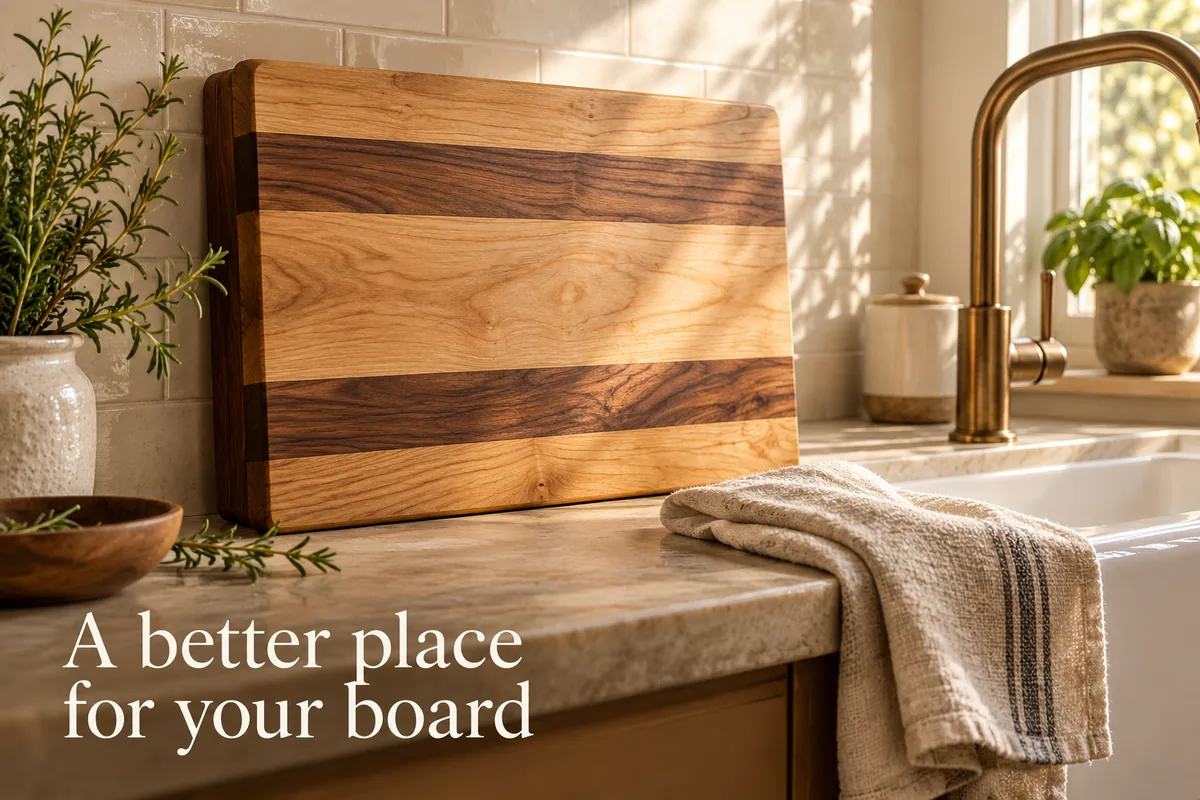
Keep the board you use every day upright and within reach of your prep area, in a divider, a deep drawer or a stable spot on the counter, and move rarely used boards somewhere else. Let each board dry completely on edge before it goes away. Before buying a rack, measure the board including handles and feet, and the cabinet opening at its narrowest point.
Why do the boards keep ending up on the counter?
Take the boards out and arrange them by use: everyday prep, raw-food tasks, occasional baking, and serving. Notice which one you reach for first. If you have to remove three roasting pans to retrieve it, the counter may be compensating for inconvenient storage.
Keep food tasks clear. U.S. government guidance recommends separating boards for raw animal foods from those used for produce or foods that will not be cooked. Your storage system should help you tell them apart, rather than hiding every board in an indistinguishable stack. See the food-safety guidance on separate boards.
What should you measure before choosing a rack?
Measure the board's full height, width, and thickness, including a handle, feet, or any thick edge. Then measure the cabinet opening at its narrowest point. Note hinges, face frames, shelf supports, plumbing, and anything else the board must pass on the way in.
For a divider or rack, find the usable slot width and height, not just the outside dimensions. Check whether a thicker board can slide in without being wedged. Include space for your hand; fitting the object is only half the task.
Example: a 16-inch board looks like it fits a cabinet 18 inches deep. But if a hinge narrows the opening or a shelf stops you tilting it in, it won't go. Test the actual route.
When is upright storage the better choice?
An upright arrangement can let you select one board without lifting a pile. It is useful when a cabinet has sufficient height and a clear approach. Test the heaviest board as well as the thinnest one: the holder needs to stay stable when you remove an item from one side.
Don't force an extra board into a full rack. You should be able to put each one back without scraping its neighbors. If the holder slides forward when you pull a board, it isn't stable enough.
Measure sheet pans separately if you want to store them in the same system. Their rims, handles, and heights create different space requirements. A rack that organizes boards neatly may not be a good match for your pans.
Can you keep a board in a drawer?
A drawer can be convenient when it opens fully and the board lies comfortably within the usable space. Check the drawer maker's load limit and include the weight of everything already stored there. Do not assume a deep drawer can carry a heavy stack simply because the stack fits.
Put the daily board where you can lift it without first moving sharp tools or a pile of utensils. Separate occasional serving pieces if they make retrieval awkward. If the board is too large to grasp at its edges, a different orientation or location may work better.
Use this practical test: open the drawer, take the board to the prep area, then put it back. If you need to rearrange the contents during either action, solve that interference before buying an insert.
Where should a wet board go?
Follow the maker's directions for drying. A cutting-board manufacturer advises drying promptly and storing its boards upright in a dry location away from heat and moisture extremes. Its instructions support an important separation: a tightly packed cabinet slot is not automatically an appropriate drying position. See the board-care instructions.
Reserve a stable place near the sink for the washing-to-drying stage. Once the board is ready for storage under its care directions, move it to the cabinet, drawer, or counter position. Check both faces and the lower edge rather than judging only the side you can see.
If there is no practical drying location for an oversized board, that is useful information before your next purchase. A board should fit the cleanup routine as well as the prep surface.
Are door racks and hanging hooks worth considering?
They can use an overlooked area, but measure the closed position carefully. A cabinet-door rack may hit a shelf or the items behind it. A hook needs a suitable hanging feature on the board and an attachment method approved for the wall and expected load.
Use screws, not adhesive tape, for anything that holds weight, and follow the holder's load and surface limits. In a rental, check what changes are allowed first.
What if the board stays out all the time?
Choose the position deliberately. Keep the main prep area usable, make the board easy to move for cleaning, and avoid a spot that is repeatedly wet from the sink. A board leaning loosely behind a busy faucet is not automatically a stable or convenient arrangement.
Try the new setup for a week of normal meals. Notice where the board lands when you're tired. If it keeps ending up somewhere else, move storage to match the habit.
Keep working through your next question
Build a safe washing and maintenance routine. Decide whether a wall shelf will really help.
Before buying a rack or insert
- Board dimensions including handles, feet and thick edges
- Cabinet or drawer opening at its narrowest point
- Slot width and height inside the rack, plus room for your hand
- Drawer load limit, counting what's already in it
- A drying spot near the sink so boards go away dry
Common questions
Is it better to store cutting boards flat or upright?
Upright usually works better in a small kitchen: you can pull one board without lifting a stack, and air reaches both faces. Flat storage is fine in a drawer if boards are fully dry.
Can I store a cutting board under the sink?
It's not ideal. The area can be damp and close to cleaning chemicals. Choose a dry cabinet or a spot on the counter away from splashes.
How do I keep raw-meat and produce boards apart?
Give each a fixed slot or use boards that look different, so you can tell them apart at a glance. Food-safety guidance recommends separate boards for raw animal foods.